
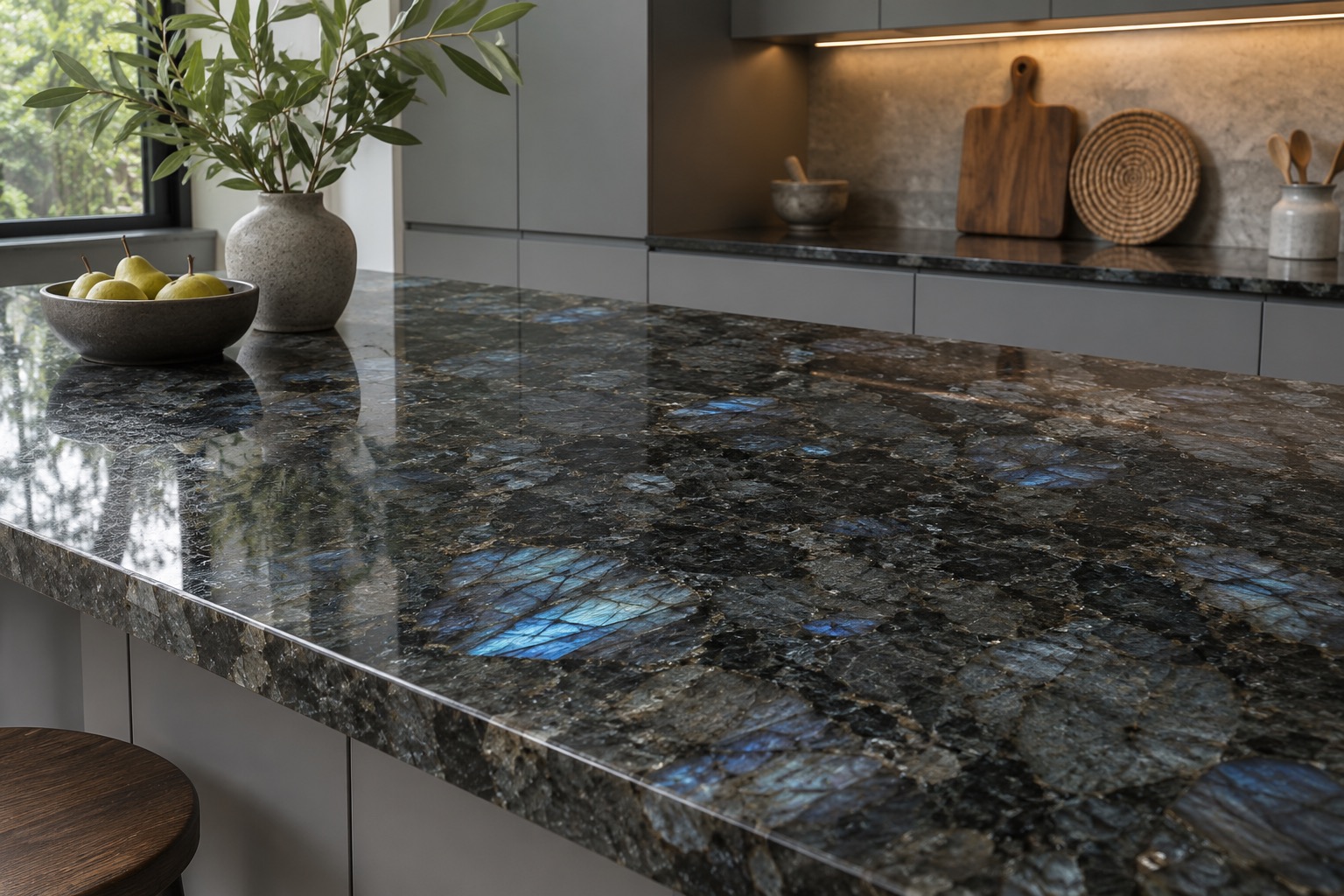
Buy a labradorite countertop for the particular slab you love, after its identity, fabrication plan and care requirements are clear. The blue flash can be compelling, but neither the sparkle nor the word “granite” tells you how a sink edge will handle an impact. For a busy kitchen, keep using cutting boards and suitable trivets, and ask the fabricator about the actual stone before paying a premium.
Some owners describe enjoying these surfaces through everyday cooking; others decide the complete project costs more than the appearance is worth to them. Those individual experiences cannot establish a scratch rate, a safe impact load or a lifespan for your slab. The choice is personal, but the checks can be concrete.
First, separate the mineral from the slab name
Labradorite is a plagioclase feldspar, not a complete rock classification. The Gemological Institute of America’s review of optical effects explains feldspar color effects through fine internal structures interacting with light. That explains a visual attraction, not the strength of an installed countertop.
“Labradorite granite,” “Lemurian Blue” and similar sales names need a supplier-specific description. Ask for the geological identification, quarry or extraction declaration, slab reference, finish and any resin or other treatment. Do not assume every slab with a blue flash is the same material, or that the name establishes Chinese origin.
Nor should every pearl-like stone be described as containing labradorite. Lundhs identifies its larvikite as a monzonite with color play associated with alkali feldspar. Its Blue and Emerald products give documented alternatives to inspect; that classification should not be transferred automatically to another seller’s Blue Pearl or Emerald Pearl.
See the flash where you will actually stand
View the whole slab from both ends, with daylight and the task lighting planned for the room. Move around it. A patch that flashes strongly at one angle can be quiet from another. Check from seated height if the stone will face dining seats, and compare the island with the perimeter counters.
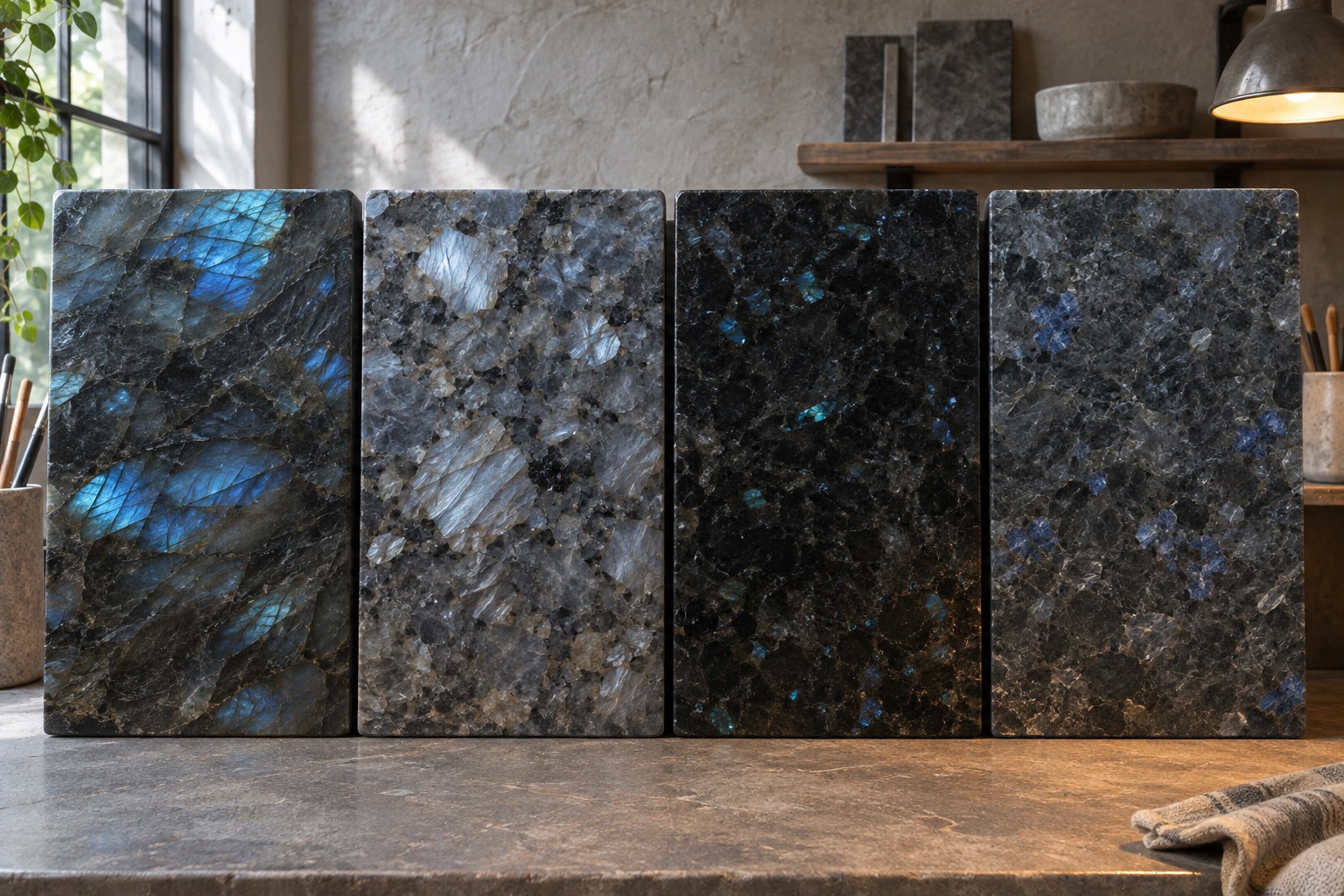
Treat names such as “Extra” as a seller’s grade unless the seller supplies a written definition. No common numerical flash-percentage grading standard is established here. Agree what the offered grade means and retain photographs of the actual numbered slabs. The Black Galaxy buying guide explains another dark-stone selection where a trade name alone cannot replace viewing the material.
Approve the cutting layout as well as the slabs. Mark the island, sink, visible edges and seams on that layout. A visually quiet patch may land in the most prominent position after cutting. Ask to see how the intended seam and edge will look; neither a large slab nor an irregular pattern guarantees an invisible joint.
Scratching, chipping and dull marks are different problems
There are no quantitative, long-term comparative kitchen data established in this guide for slabs sold under the broad labradorite countertop name. A mineral hardness value would not answer how a particular cut-out, edge, fissure or repaired area responds to impact.
| Concern | What to establish before ordering |
|---|---|
| Scratches or abrasive wear | Finished-surface care instructions and an agreed sample; keep grit off work surfaces and use a cutting board |
| Chips at an exposed edge | Fabricator’s proposed profile, vulnerable corners and repair appearance, using experience with the offered material |
| Cracks around a sink or overhang | Written support and cut-out plan from the responsible fabricator and installer |
| A dull or cloudy patch | Cause and treatment compatibility; do not assume it is a scratch or simply missing sealer |
Avoid testing a purchased slab by striking it with cookware. An owner’s report of no damage from a pan does not make that a safe acceptance test. If damage occurs, document it and obtain an assessment before attempting the methods discussed in the repair guide.
Get a care plan for this stone and its treatments
The Natural Stone Institute says sealing is not necessary for every granite countertop. Ask whether the offered surface needs an impregnating sealer, which product is compatible with its treatments and food-preparation use, and what condition should trigger reassessment. A universal annual schedule is not established for this stone.
Its care guidance recommends neutral stone cleaner or mild detergent, rinsing and drying, and discourages acidic cleaners even for siliceous stone. Avoid vinegar and abrasive cleaning powders; follow the selected product’s directions. Use trivets and blot spills promptly.
An impregnator improves stain resistance; it does not make stone stain-proof or protect edges against impact. A dull patch could involve residue, minerals or a surface treatment. Resealing is not a universal cure, and polishing should follow diagnosis. Use the sealing and stain-removal guides to frame questions for the supplier rather than choosing a chemical by the slab’s color.
Compare complete quotes, not a dramatic slab price
A reliable same-region, same-grade installed price comparison is not established here. Personal quotations cannot tell you what your kitchen will cost. Ask competing suppliers to price the same drawing and scope, with the following separated:
- Material: identified slabs, usable dimensions, number purchased, delivery and ownership of remnants.
- Fabrication: templating, slab layout, edge work, cut-outs, seams and any proposed reinforcement or treatment work.
- Installation: transport, access equipment, supports, fitting, plumbing coordination, removal and disposal, taxes and exclusions.
Ask each supplier to explain its own cost differences. A quotation may include different work, different access assumptions or a different number of slabs. Compare the finished project and written responsibilities before concluding that one fabricator is simply expensive.
When an alternative makes more sense
Ask to view Blue Pearl, Emerald Pearl and Volga Blue beside the preferred slab if you like a dark base with flashes. Treat these as a viewing shortlist, not a proven ranking for price or durability. Confirm the identity and documentation of each offered product. A locally available alternative is useful only if its actual appearance, care plan and complete quotation suit you.
Choose the more expressive slab if you still prefer it in ordinary room light and accept the documented project cost. Choose another stone if you like its quieter appearance or its specific quotation and support arrangements better. The absolute-black guide offers another way to think about a restrained dark worktop.
Blue reflections do not establish translucency. If backlighting matters, require a demonstration through the actual slab thickness and backing, plus a maintainable lighting design and separate quote. For a bathroom, obtain written confirmation for the particular vanity or wet-area assembly and its cleaning products; a kitchen example alone does not establish suitability.
Before you pay a deposit
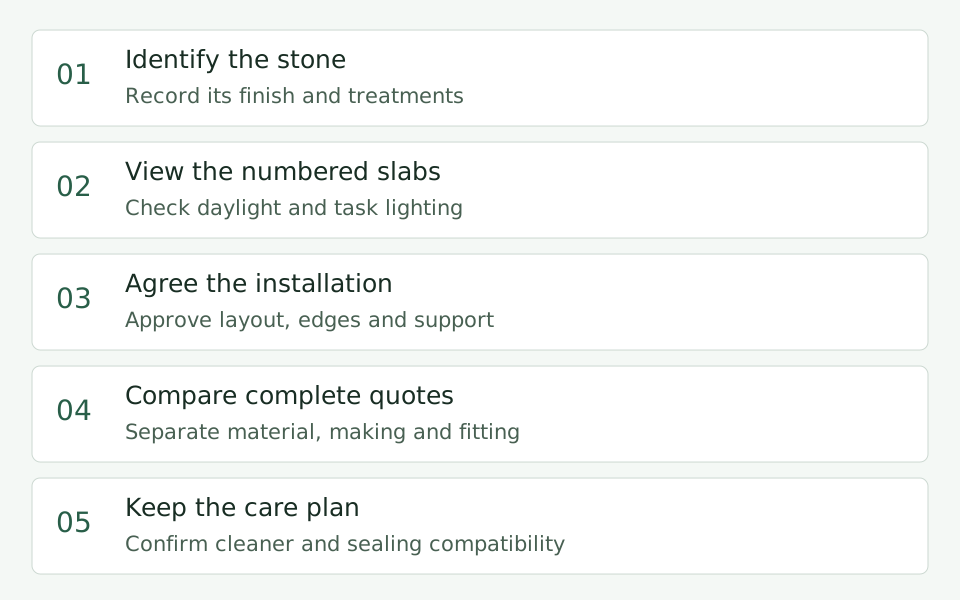
Keep one record containing the stone identity and treatments, numbered slab photographs in relevant light, approved cutting and support drawings, itemized quotation, and written cleaning and sealing instructions. Clarify who handles a damaged piece or an unacceptable visual mismatch.
Wait for a slab you prefer when the appearance matters enough to justify the delay and full cost. Compare alternatives when their actual offers suit your budget better. Pause the purchase if the supplier cannot identify the material, explain its treatments or commit to a workable installation plan.
Sources
- Structures Behind the Spectacle: A Review of Optical Effects in Phenomenal Gemstones and Their Underlying Nanotextures — Gemological Institute of America. Mineral identity and optical effects; not a countertop performance test.
- What is Larvikite? — Lundhs Real Stone. Producer description of larvikite and its Blue and Emerald products; not verification of every similarly named product.
- Statement of Position on Sealing Natural Stone Countertops — Natural Stone Institute. General sealing guidance, not a care specification for an unidentified slab.
- Care & Cleaning of Natural Stone — Natural Stone Institute. General cleaning, staining and treatment boundaries.
- Reddit discussion · r/CounterTops · 78 comments
Questions & discussion
Share a question or a useful experience about this guide. Comments appear immediately. Your name and comment are public. Email is optional and stays private; reply emails are not enabled yet. Comment privacy.